Mediawatch-UK

Friday, 5 December 2014

Violent game banned by Australian retailers


This week Target and Kmart, two of Australia's largest retailers, took the decision to remove the controversial video game Grand Theft Auto 5 from their stores because of its graphic scenes of violence against women.

Grant Theft Auto 5 is the latest title in the successful gaming series and was released a year ago.  It is set in the fictional American city of Los Santos and gamers control criminals as they rampage through the town committing a series of crimes to rise to the top of the gangster underworld by any grotesque means necessary.  It has been criticised for its levels of violence, particularly for its depictions of torture and the way it often portrays women as strippers and prostitutes.  The Guinness Book of Records has named the series as the most controversial video game in history

Explaining its decision, a spokesman for Target said it had “been speaking to many customers over recent days about the game, and there is a significant level of concern about the game's content.  We feel the decision to stop selling GTA5 is in line with the majority view of our customers.” 

Clearly the chain’s decision was business focused rather than part of a wider moral crusade but it was prompted by a petition calling for its removal from stores because of the levels of violence against women.  It is worth noting that Grand Theft Auto allows players to be violent not just towards women but men too.   However GTA’s depiction of female characters is broadly one dimensional with women portrayed in the main as prostitutes, nags or powerless damsels in distress; hardly a healthy role model for the 21st century.

GTA is no stranger to controversy and it has come to be seen as the nadir of violent gaming.  However, there are equally concerning games such as the updated version of 90s bĂȘte noire Mortal Kombat which allows players to kill their opponents in numerous stomach churning ways and Call of Duty is infamous for the episode in which players are invited to slaughter bystanders in an airport.

There are lots of games which are not violet and misogynistic but it’s the nature of promotion today that, in order to secure media coverage, developers need to provide a product that will be talked about and sometimes pushing the boundaries is an easy way to do this.  We’ve seen the same in other forms of media including music videos.

There has been a backlash from gamers against Target’s decision but so often the level of debate has descended to ‘I play GTA and I don’t run down prostitutes’ - but this is missing the point.  Research from Canada published earlier this year looked at far more subtle, but equally concerning, links between the types of games played and gamers’ moral reasoning and ability to take the perspective of others into account.

Hours spent playing violent video games was found to be effectively stunting emotional growth. Interestingly, there was no correlation between the amount of time reported playing non-violent video games and moral reasoning levels.

Following the ban in Australia there has the predictable outpouring of threats and abuse against those who initiated and signed the petition.  Perhaps this toxic behaviour is itself an illustration of the possible effect of these violent games.


If you are thinking of buying a console such as Xbox One or PlayStation 4 this Christmas it’s worth bearing in mind that there is nothing wrong with gaming per se – as long as players don’t spend too long doing it.  The key is keeping abreast of the content of the games being played on the device.  Grand Theft Auto 5 is rated 18 and this rating is not an indication of skill but of content.  In the same way most responsible parents would not be happy with their children watching an 18 rated DVD they need to keep a similar eye on the games which are being played and make sure that they use the parental controls available on these platforms to protect their children – not just from age inappropriate games but, as these consoles can be used to access the internet, from potentially harmful online content too.   You can find out how to do this here for Xbox products and here for PS4.

Defeat in the Lords but we keep fighting


Thank you for taking the time to use our campaign website, Safeonline.org.uk to contact a peer and encourage them to support Baroness Howe’s amendment to the government’s Consumer Rights Bill.  Lady Howe’s amendment required all ISPs and mobile phone operators to provide their customers a service free of adult content unless they opted in to receive it and made provision for robust age verification to guard against abuse of the system.

So many people responded that we estimate that every peer received at least one email of encouragement.  Lady Howe was delighted with the level of support that she had received and asked me to pass on her thanks.

Sadly the amendment was not carried with 65 peers voting for it with 124 voting against.

As the Government did not support the amendment, we always knew that an early vote would be crucial to success and, unfortunately, the debate went on into the evening by which time many non-government peers had gone home.

It is deeply frustrating that, at the end of the day this should come down to something as capricious as timing rather than the quality of the arguments.  There were great contributions from Lord Cormack and Lord Framlingham who both defied their Party whips and voted for the amendment.

Although disappointing we should also take encouragement from the result.  The majority of Peers spoke in favour of the amendment and in her summing up Lady Howe noted: “each time one puts pressure on the Government, it improves the situation”

The peers who voted for the amendment included Labour, Conservative, Liberal Democrats and cross-benchers.  Clearly this is an issue which transcends party boundaries and shows the strength of feeling on this issue.  You can read the debate here, beginning on page 35.

Thank you once again for your support which, had timings been different, would have carried the day.  All is not yet over and we look forward to being able to write to you with the good news of statutory protection in the not too distant future.

Friday, 21 November 2014

Have Your Say: a real chance to see real change.


http://www.safeonline.org.uk/

Campaign update:


Over the past year we have seen some real progress in our fight to protect children from harmful online material. 


The Government has worked with some Internet Service Providers to come up with a voluntary industry agreement to protect children which being called ‘default-on’.  This represents an important step forward but, crucially, it leaves over10% of the home broadband market and hundreds of thousands of children beyond the agreement.  It is a good start but will only be really effective if accompanied by robust age-verification for users which is sadly lacking from the industry’s own proposals.


That the current arrangements are insufficient was eloquently illustrated by an ATVOD report in March which showed that in one month 44,000 primary school children had accessed porn sites and 200,000 children under 16. In August a judge sentenced a boy for raping a 10 year old girl noting that he was acting out hard core porn he had freely accessed from the computer in his bedroom.


We believe that self-regulation is not a credible long term solution and that statutory backing is needed.


If we keep things solely on a self-regulatory basis we will have no long term security.  It may be that under intense political and media pressure today the industry will get its house in order, but where will we be in five, ten or twenty years’ time?  If it is true, as the Prime Minister has said, that ‘few things are more important than this,’ why is it that we have laws on myriad eventualities but nothing in relation to one of the most important areas currently affecting us and our children?


Last January Baroness Howe moved an amendment to the Children and Families Bill to address these issues.  Although the amendment was lost, a very considerable vote was secured and many have said that had the vote not been delayed until 8.30 in the evening it would have been won.


The Government has failed to do anything substantive in the intervening period to deal with the problems that the amendment addressed.  Mindful of this Baroness Howe has introduced an amendment (50D) to the Consumer Rights Bill which will be debated in the House of Lords on 26th November.  If accepted this clause would require:


  • All Internet Service Providers and mobile phone operators to provide, as a default, an internet service without access to pornography – with adult subscribers able to opt-in to receive such material.
  • The provision of really robust age-verification procedures.


Please act now:


If you agree that it's time the law was used to protect children in the online environment as it is offline please email a cross bench peer and encourage them to attend The House on 26th November and support the Bill.


We have updated our campaign website, www.safeonline.org.uk, to enable you to do this quickly and easily.  Time is of the essence but this is such a wonderful opportunity to have a real influence we hope you won’t want to miss it.


If you are pushed for time Safeonline includes a quick and easy template letter that you can use.  The whole process should take no more than a couple of minutes and it could make all the difference.

Monday, 10 November 2014

The cause of ratings creep: desensitisation


The November issue of Pediatrics magazine includes the findings of some very interesting new research which suggests that viewers may be partly responsible for ‘ratings creep’ which has seen younger children exposed to increasing levels of on screen sex and violence.

The study found that parents become desensitised over time when viewing material featuring ‘adult’ content; viewers watching a series of bloodthirsty or erotic scenes were less able to gauge their suitability for children as time went by.

Researchers showed a series of clips with similar levels of sex and violence to parents of children aged six to 18 and asked them to give each selection an age rating. The study found that viewers of the first scene felt an appropriate age would be, on average, 16.9 for violent content and 17.2 for sexualised content. But by the time they had watched the sixth scene, respondents’ perception of the appropriate age had dropped to 13.9 for violent content and 14 for sexualised content.

The authors of the study also suggest that the desensitisation phenomenon could affect other frequent film viewers, such as those who decide the age appropriate level of films.  This would help explain the long-term “ratings creep” phenomenon which has seen censors on both sides of the Atlantic relax ratings.  Indeed an American study conducted last year found that films rated PG-13 now contain more gun violence than those rated R (not suitable for under 17s) and that gun violence in PG-13 films has tripled since 1985.

The phenomenon was illustrated in the UK this week:

Appearing before a meeting of the Commons culture, media and sport committee, outgoing Ofcom Chairman, Ed Richards, told MPs that Ofcom have found only 35% of viewers think there is too much violence on TV, down from 55% in 2008, while 26% believe there is too much sex.  Just 35% think there is too much swearing; down from 53% six years ago.

“There has been a big change in this over the years,” said Mr Richards.  “People are more tolerant of a degree of violence than they were. They are much more tolerant of certain forms of swearing than they were.”

This is a perfect illustration of what happens after decades of constant exposure to questionable content; we become desensitised and the boundaries of what is considered acceptable are constantly pushed back.  What the long-term consequences of this desensitisation might be for the next generation remain unknown.

Friday, 24 October 2014

Watershed protections online


Earlier this year the Director General of the BBC, Tony Hall, announced plans to make BBC 3 – the corporation’s ‘youth’ channel – a completely online channel.  Despite opposition from presenters and some executives the new head of the BBC Trust, Rona Fairhead, has hinted that the trust will approve the move saying that the BBC should do even more to cater for young viewers who prefer to watch television on their tablets and mobile phones.

Speaking to the culture, media and sport committee she said: “The statistics show that this group are watching less. They are certainly watching very differently…. typically they watch on-the-go through the devices they have.  Catch up television appears to be a way the younger audience will use the BBC and view programmes.”

BBC Three is the most successful youth television station with more viewers aged 16 - 34 than any other youth television station including E4, Sky 1 and ITV2.  Shows such as Bad Education and Being Human attract almost 30% of this age group on a weekly basis; they also attract many much younger viewers.

Over the years the channel has produced some excellent programmes including My Brother the Islamist, Autistic Me, and Blood, Sweat and TShirts.  Earlier this year it broadcast a documentary, Porn, What’s the Harm, which raised some important questions for young adults but was unsuitable for younger children.  However the channel has also broadcast some potentially harmful content including in 2012 Like a Virgin, which followed girls preparing to lose their virginity, in which a bikini wax was given more attention than a safe sex message – which is contrary to government guidelines.

Presently the channel broadcasts from 7pm to 4am, largely post-watershed.  Much of the channel’s content is available online with a parental guidance prompt and can only accessed by ticking a box confirming that the viewer is over 16 – hardly beyond the wit of a much younger child.  Moving this channel online without updating the protections will compound the problem.  Any existing computer filters are unlikely to block access to iPlayer and, as the parental control feature is not widely advertised, it is reasonable to assume that the majority of parents will not have set up controls to protect their children. 

When the BBC Trust looked at the iPlayer back in 2010 we asked them to consider the inadequate protection available.  We called for a more robust system to protect children.  The Trust did not address this in their findings but they did recommend more was done to advertise the available parental controls.  However this has not happened.

We have written to Rona Fairhead outlining our concerns about the lack of protection for children afforded by the BBC’s iPlayer.  We have pointed out that, should BBC 3 move online, these problems will be magnified and we have asked her to consider ways in which the protections offered by the television watershed could be replicated online.

Monday, 20 October 2014

Mary Whitehouse on the BBC


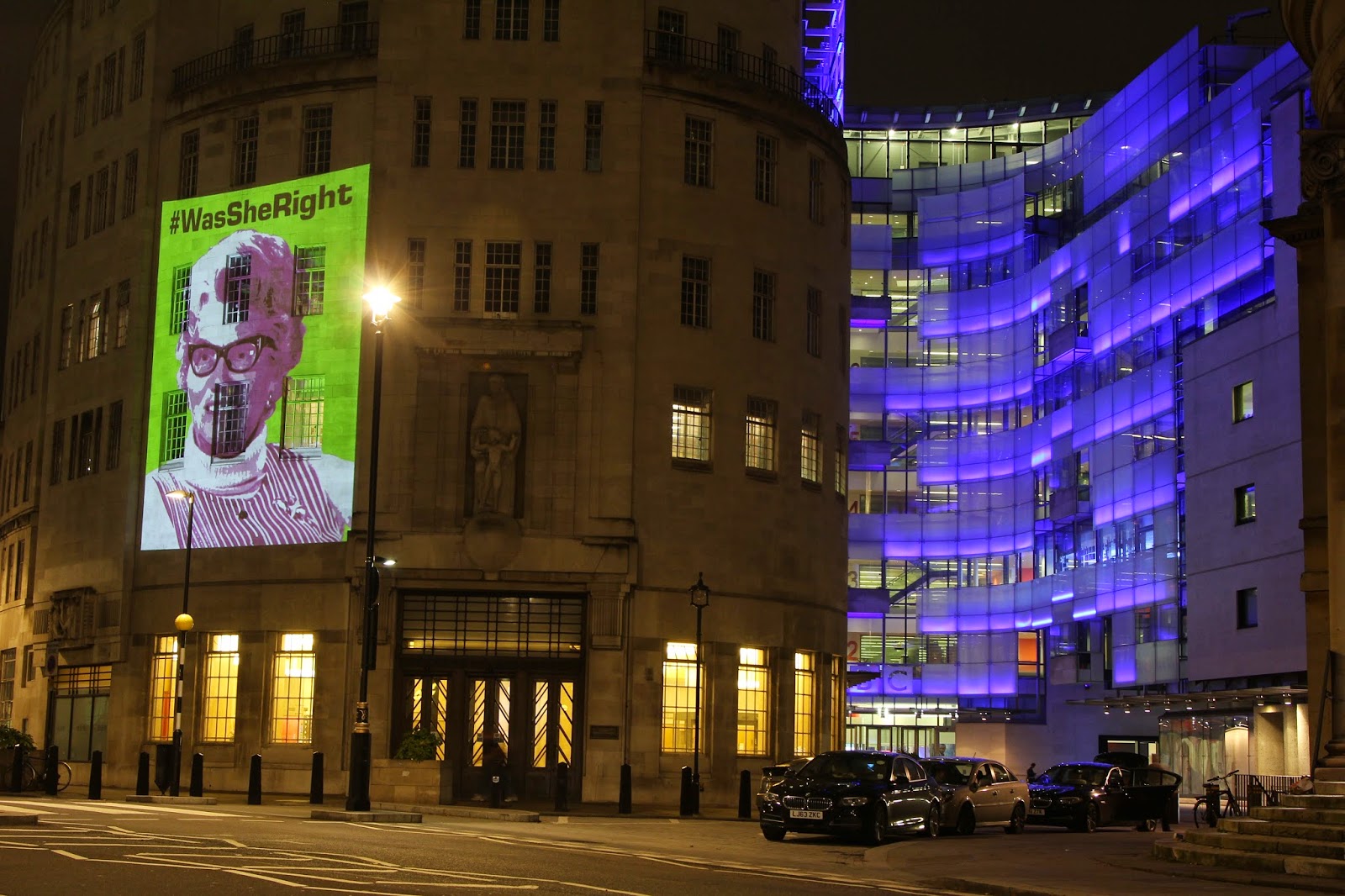
This is a picture of the projection on the BBC’s Broadcasting House.  Mary Whitehouse was famously blocked from appearing on the BBC during the 1960s because of her criticism of the corporation’s output which she believed was potentially harmful. 

Last Tuesday evening, we projected images of Mary Whitehouse in locations all over London asking people to consider whether or not she was right all along.  At the same time we released the results of new research which we commissioned to mark our anniversary.  We wanted to know what the British public felt about the state of media, its impact on today’s society and whether the public feels confident that complaints about disturbing or unsuitable content are being dealt with effectively.

Our investigation found that, overwhelmingly, the public think programme makers and schedulers crossed the line in allowing increasingly inappropriate content to invade our screens.  Everyone surveyed reported viewing inappropriate content before the watershed, including: violence, sexual activity, racism and offensive language.  However, only 26% had actually done anything to express their dissatisfaction because they do not feel their voices are being heeded when they complain.

The highest percentage of complaints was made about sexual activity (47%), followed by offensive language (38%), violence (36%) and inappropriate adult issues such as drug taking, gambling etc (34%), all shown before the watershed. More people had complained about content involving sexual violence (33%) than about racism or other discriminatory content (21%).   This would not have come as a surprise to Mary Whitehouse who said of television: “if it is sometimes a debasing influence, it could equally be a great ennobling force if we cared enough.”

When respondents were asked whether inappropriate content might have an effect on people’s behaviour, 94% believed that it could, citing violent horror, explicit sexual content, music videos and soap operas as particularly problematic.  With such a high percentage of the public feeling that this kind of subject matter can be potentially harmful, Mediawatch-UK believes that broadcasters have a duty to take this more seriously.

Writing in 1977, Mary Whitehouse said: “What we are is inseparable from the cumulative effect of all that we have seen, read and experienced.”  How prescient this seems now.   

39% of those surveyed said they hadn’t bothered to make a complaint because they either feared that nothing would be done about it, they didn’t know whom to contact or sometimes they didn’t want to be seen as a ‘complainer’.  They gave a number of reasons for this:  


Of those that did complain, either to their media provider, TV station, the programme makers, OFCOM or via social media, 40% either received no response at all or were dissatisfied with the outcome.  Many received a computer-generated form which was never followed up.  Others felt strongly that if the body to which they had expressed their complaint had simply apologised they may have been satisfied, but they were denied even that small gesture.

OFCOM’s failure to regulate adequately in the past has led to what the regulator itself described as being ‘at the very margin of acceptability’ to become mainstream. Is it then any wonder that people are not making their views known about inappropriate broadcasts because they don’t think anything will come of complaining.   

Many today would concur with Mary Whitehouse’s comment on the TV regulator: “Instead of the government providing a vehicle for the voice of the viewer, it has provided little more than a convenient means for the broadcasters to deflect criticism of their programmes.”  It would appear that Mary Whitehouse was right after all.

Friday, 3 October 2014

Age ratings for music videos


Today sees the launch of a pilot scheme to introduce film-style age ratings for music videos to help protect children from unsuitable content.  This has come in response to huge public concern that what has become mainstream in music videos in recent years is now barely inches away from pornography. 

Recent videos from Britney Spears, Rhianna and Miley Cyrus have included nudity, highly sexualised dancing and imagery and visual references to prostitution.  What is particularly disturbing about this is that the fan base of all these performers is so young.  Watching them, one could be forgiven for thinking that these videos have been produced to appeal to an adult male audience but, in reality, they are far more likely to be viewed by school children.

Parents who responded to the government’s Bailey Review in 2011 cited music videos as a major concern.  The report subsequently recommended that age restrictions should be applied to music videos to prevent children buying sexually explicit videos and guide broadcasters over when to show them.  Ministers called on the industry to develop solutions so that more online videos, particularly those that are likely to be sought out by children and young people, carry advice about their age suitability in future.  This new scheme is a response to that call.

The new measures will see websites YouTube and Vevo and three of the UK's top music labels - Warner, Universal and Sony – working with the BBFC to apply age ratings to videos before they are made available online.

Presently this classification will be limited to the UK, so it will not apply to some of the most explicit videos by the likes of US stars Miley Cyrus and Jennifer Lopez but the Chief Executive of the music industry body, the BPI, is hopeful that "other countries might see we're taking a lead, and if it works they might follow suit."

This is a welcome move and we will be watching with interest to see how it works in action.  However, the scheme is a voluntary one but for maximum impact it needs to be mandatory across the industry.  It will not be the ‘silver bullet’ which guarantees protection to children watching music online but it does offer parents another useful tool to help them safeguard their children and it is an important first step in establishing very clear boundaries on acceptable standards in videos.